

Buyers are asking ChatGPT, Perplexity, and Google’s AI Mode for recommendations before they ever type a query into a traditional search bar. Every one of those answers gets built with your content, or without it.
That shift has a name, Generative Engine Optimization (GEO). The more useful question for most marketing teams isn’t what GEO is. It’s whether they’re actually ready for it.
That readiness shows up in five separate areas. Unfortunately, most teams are solid in one or two and behind in the rest without realizing it, but to save you the headache we wrote this article to help you find out where you actually stand.
1. Content Structure
Is your content written in a way AI can actually retrieve?
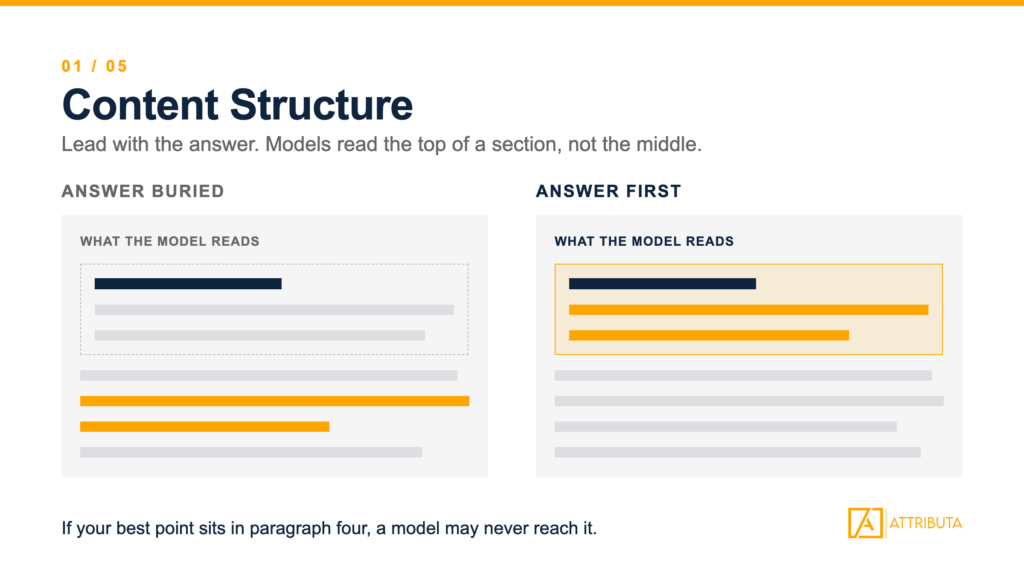
Generative engines don’t reward keyword density the way traditional search once did. They reward content that answers a question clearly, in the first few lines, without making the reader, or the model, dig for it. Lead with the answer and support it after.
FAQs, semantic headings, and short paragraphs matter here because AI summarizers tend to pull from the start of a section, not the middle. If your best point sits in paragraph four, a model generating an answer in real time may never reach it.
Ask yourself: If an AI tool only read the first two sentences under each of your headings, would it still get your point right?
2. Digital Authority
Are you recognized as a thought leader in your space, or just a participant in it?
AI systems don’t cite random pages, but they do cite sources that show up again and again across a topic: a body of work that covers a subject from most of the angles a buyer might ask about, not one strong blog post surrounded by thin ones. Some teams call this topic ownership, a connected set of content instead of scattered pages competing against each other for the same keyword.
Consistency matters as much as volume because AI models build something close to a profile of your brand. If your name, description, or point of view shifts from page to page, that profile gets harder for a model to trust or cite.
Ask yourself: If a model pulled everything you’ve published on your core topic, would it sound like it came from the same brand?

3. Governance
Do you have standards for metadata and taxonomy, or is every team doing its own thing?
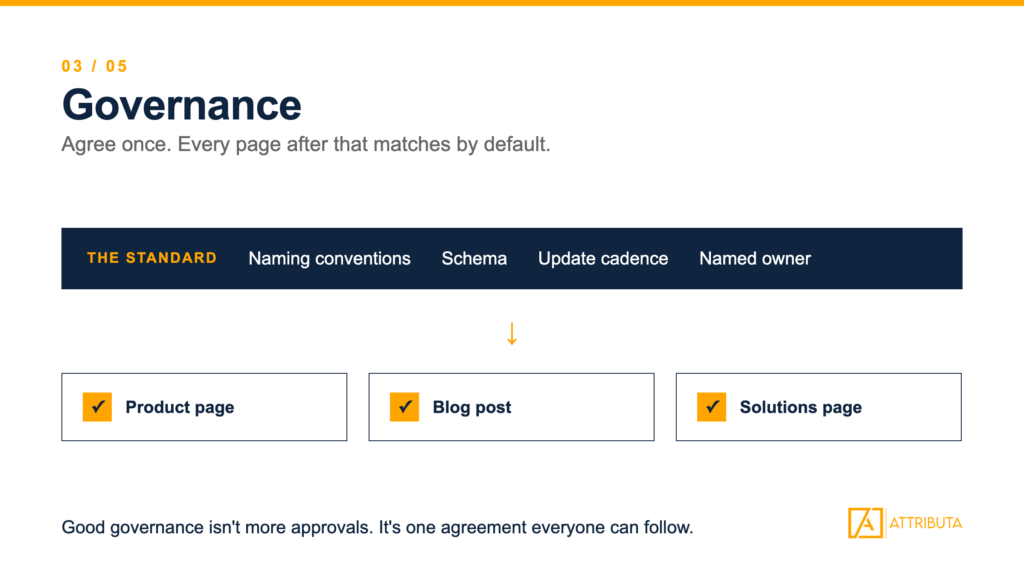
Without shared standards, content gets messy fast. This means that phrasing drifts, old stats stay live past their expiration date, and schema gets applied on some pages and skipped on others. AI systems pick up on that inconsistency even when human readers scroll right past it, because a model is weighing your content against everything else it has indexed on the same topic.
Good governance isn’t more approval steps. Instead, it’s agreeing once on naming conventions, an update schedule, and who is responsible for keeping content current.
Ask yourself: If someone outside your team published a page today, would it match your standards without you having to fix it after the fact?
4. Operational Alignment
Are SEO, content, ops, and analytics working toward the same goal, or operating in silos?
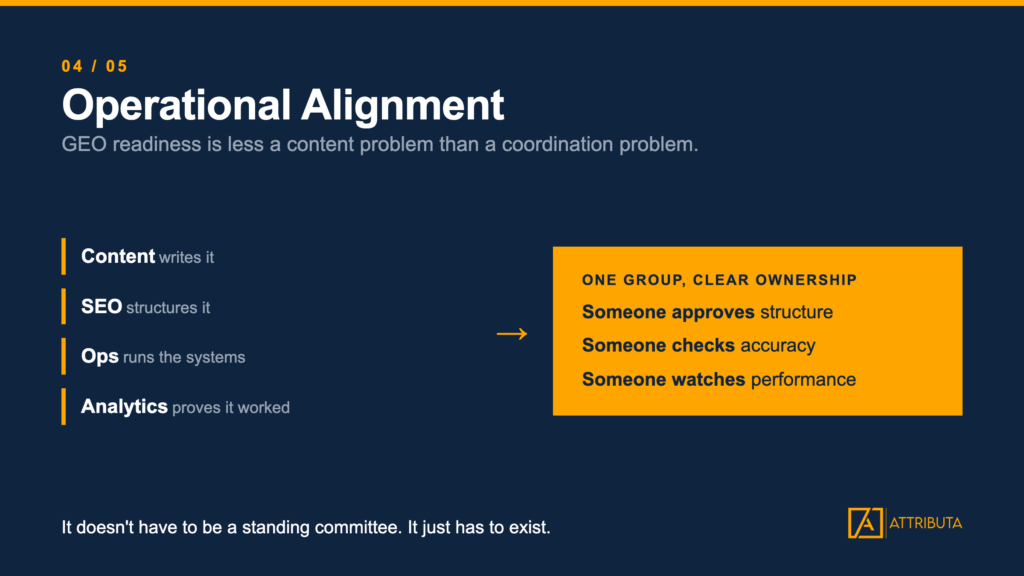
This is where a lot of teams struggle, because GEO readiness is less a content problem than a coordination problem. Content teams write it. SEO teams structure it. Ops teams manage the systems it lives in. Analytics teams are supposed to prove it worked. When those groups aren’t pointed at the same targets, work gets duplicated and nobody owns the result.
Teams that handle this well usually build a small group with clear ownership: someone approves structure, someone checks accuracy, someone watches performance. It doesn’t have to be a standing committee. It just has to exist.
Ask yourself: If your AI visibility dropped next month, would you know whose job it is to find out why?
5. Measurement
Do you have a baseline? Can you track whether you’re being cited?
Most teams skip this step entirely, thinking that AI visibility is just one number. In reality, the answer an AI tool generates and the citations behind it are two separate signals, and they don’t always move together. A brand can look strong in the generated answer while its actual sources go uncited. The reverse happens too.
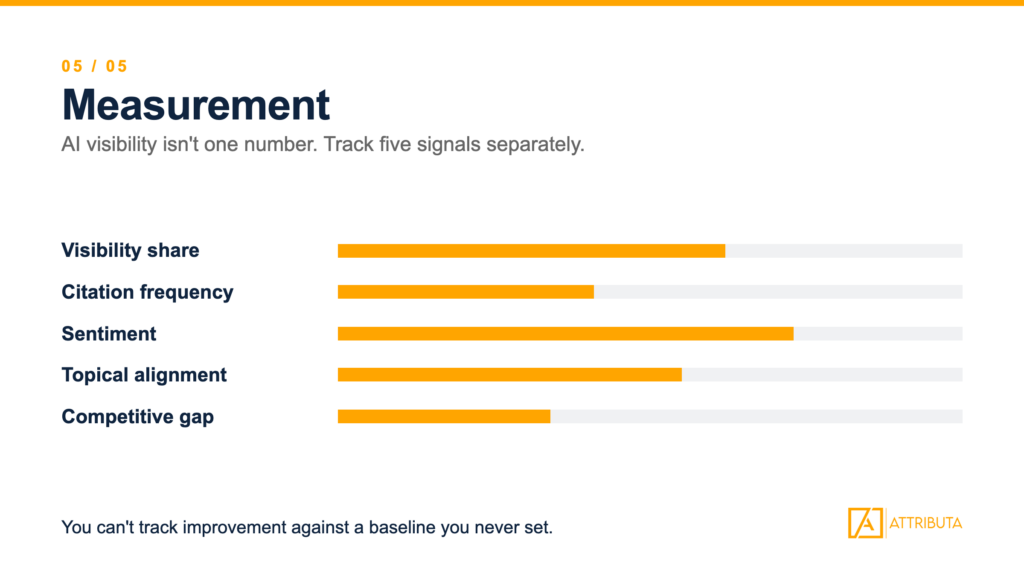
A basic measurement approach tracks a few things separately:
- Visibility share. How often your brand shows up in the AI-generated answer itself, not just in the citation list.
- Citation frequency and authority. Which sources AI engines actually pull from when they mention you.
- Sentiment. Scored separately for the answer and for the citations. A mismatch between the two often points to a content gap.
- Topical alignment. Whether AI answers emphasize the themes you want associated with your brand, or a different set entirely.
- Competitive gap. Where you lead or lag competitors, in the answer, the citations, or both.
None of this works without a starting point. You can’t track improvement against a baseline you never set.
Ask yourself: If someone asked how you’re doing in AI search, could you answer with a number instead of a guess?
Where most teams actually stand
Few organizations are weak across all five areas at once. Most are further along than they think in one or two, and behind in the rest. Measurement is usually the weak spot, since it’s the area nobody checks until a competitor’s name starts showing up in answers where theirs should be.
Knowing GEO matters doesn’t tell you where to spend the next quarter. Knowing which of these five areas is holding you back does.
Our AI Visibility Audit walks through all five and shows you exactly where your organization stands on each one.
