


Beyond SEO: GEO, AEO & LLMO Explained Webinar Recap
If you missed our most recent webinar led by our consultant and GEO expert Katie Evans, don’t worry. This article is meant to give you a clear understanding of the topics we covered, as well as answer some questions you may have about the changes in buyer behavior and brand discoverability as we dive further into the age of AI-influenced buying. Instead of arguing that SEO is dead, we will uncover how discoverability is expanding as buyers change how they search for products and services. This is true for both B2B and B2C industries.
So, What Changed?
Before AI, traditional search looked something like:
- User inputs keywords into the browser
- Search Engine Response Page responds with thousands of options
- Users manually click through websites
- Users manually compare results
Now, buyers, specifically those in SaaS, enterprise software, and professional services, open LLMs like ChatGPT or Perplexity to get an AI-generated summary and validate their shortlist before ever visiting a website. The main takeaway from these changes in buyer research is that AI is embedded into the buyer journey well before your website gets a single visit.
The Visibility Gap
What does this mean for your website? Well, your SEO specialist may be confident that your website will appear within the top 5 responses in Google. However, a company can very well rank #1 on Google but still be completely invisible when a buyer types prompts like “who are the top attribution vendors” into ChatGPT.
Google Rankings ≠ AI Visibility.
You may fall into one of these two categories: weak AI presence with strong SEO, or a strong AI presence with weak SEO. If you’re currently dominating Google’s traditional blue links with the help of keyword optimization and backlinks, you could be experiencing declining CTR at the same time. Though you may be winning brand visibility on Google, you’re not appearing in conversations inside ChatGPT or Perplexity, where your brand remains invisible.
On the other hand, if your AI visibility is strong, your brand is frequently mentioned in industry news, reviews, and authoritative discussions across the web. HOWEVER, your website’s technical SEO and keyword targeting are poor. Though users discover you through AI and come to your site as HQLs, your overall organic traffic volume might stay low due to poor site structure.
How AI Shows Up Across the B2B Buyer Journey
We covered the buyer journey prior to AI involvement. Now, the buyer journey looks like:
1. AI Research Assistant. Buyer asks questions like “What are the best marketing attribution platforms?” and AI creates the shortlist. If you’re not in the answer, you’ve been excluded before the process began.
- Validation Layer. Buyers ask, “Is this company trustworthy?” so AI reshapes perceptions and creates a first impression for potential buyers before they even get a chance to check out your webpage.
- Comparison Engine. Buyers ask, “Compare vendor A to vendor B”. AI interprets your positioning, strengths, and weaknesses.
- Decision Support. Buyers ask, “What do you recommend for a mid-market company?. AI makes personalized recommendations, so by the time someone lands on your website, their opinion is already partially formed.
Buyers now conduct their research independently, within the confines of their AI assistant tool.
The Right Response
Instinctively, as marketing teams see these changes, we want to just publish more AI-optimized content. Unfortunately, more content does not equal more AI visibility. The organizations that won at discoverability were structurally ready before publishing. This means
- Optimizing for Answer Engines (AEO): Structuring website content so AI can easily read, summarize, and cite as an authoritative and trustworthy source.
- Tracking Brand Mentions: Monitoring presence across major AI platforms, so looking at how often their brand is cited and whether AI speaks about them positively.
- Focus on Entity Mapping: Build a strong “digital footprint,” so AI models understand exactly who they are.
- For your brand to show up in AI responses, the AI needs to have a clear picture of who you are
The Ownership Problem
No single team fully owns AI discoverability, making it easy for it to fall through the cracks. While marketing thinks SEO owns it, SEO views it as a content problem. Ops hasn’t even considered it their task, and analytics is left measuring the wrong things. Though leadership wants proof, they are unsure what to ask for.
All in all, organizations that designate clear ownership and treat discoverability as a capability rather than a project will have a structural advantage.
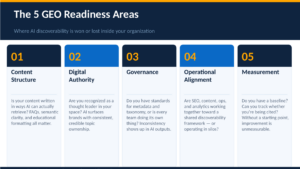
The 5 Readiness Areas Attributa Assessment
GEO readiness isn’t a single switch you flip because it spans across 5 organizational areas. Most companies are strong in one or two areas, while the others are unaddressed. If you’re still on edge about taking the leap to improve your AI discovery, maybe knowing where your gaps actually are will help you form a decision.
Take this assessment to see where you stand. It’s short and won’t take up much of your time, promise.
Attributa’s Approach
Whether or not you work with Attributa, knowing where to focus your GEO efforts is half the battle. That’s the problem our tool was built to solve. It evaluates your current position across the five readiness areas and identifies where your time will have the biggest impact on AI discoverability. You don’t need to boil the ocean. You need to know which levers to pull first.
The tool is available at three levels, depending on how much guidance you want:
Free: A scored baseline across all five readiness areas that points you in the right direction. You’ll see where you stand and which areas need the most attention, at no cost.
$99: Unlocks a 90-day roadmap tailored to your specific gaps. It gives your team a clear sequence to follow so you’re not guessing what to prioritize. You can execute it entirely on your own.
$500: Unlocks prompt-level recommendations with specific, actionable steps to optimize for the exact queries your buyers are using in AI tools. This tier is for teams that want to move fast on a targeted set of high-value prompts.
The tool is designed to help you make better decisions about where to spend your time, whether that’s with Attributa’s support or on your own. Start with the free version and see where it points you.
Check it out: https://attributa.io/llm-discoverability-audit/
